CY0-001 Practice questions
CompTIA SecAI+ v1 Exam
0/5 checked
- free questions
- 5
- with answers
- in the full set
- 159
- question types
- 3
Updated
-
Question 1
Single answer
Which of the following job roles in an organizational governance structure develops a model from business use cases?
Show answer
Correct answer
-
D
Data scientist
Explanation
Basic Concept: In AI governance, each role holds distinct responsibilities. Understanding these roles is core to CompTIA SecAI+ Domain 4 (AI Governance, Risk, and Compliance).
Why D is Correct: The Data Scientist is responsible for translating business use cases into working AI/ML models. They analyze business requirements, identify the appropriate machine learning approach, and develop models that fulfill specific business objectives. According to the CompTIA SecAI+ Study Guide, data scientists bridge raw data and actionable AI solutions by building and validating models derived from business-driven needs.
Why A is Wrong: A Platform Architect designs and manages the infrastructure and technical platforms hosting AI systems. Their focus is architectural design of the environment, not model development from business use cases.
Why B is Wrong: An AI Risk Analyst identifies, evaluates, and mitigates risks associated with AI adoption. Their role is governance and risk-oriented, not model creation.
Why C is Wrong: An MLOps Engineer operationalizes, deploys, monitors, and maintains AI models in production. They take models already built by data scientists and ensure reliable operation at scale, not develop them from business use cases.
No comments yet. Start the discussion.
-
D
-
Question 2
Multiple answer
An airline corporation wants to implement a chatbot application using a large language model (LLM) so its customers can ask questions and receive answers about flight details and have the option to upload files.
Which of the following security controls should the airline use to protect against malicious input and unauthorized use beyond the service-level agreement? (Choose two.)
Show answer
Correct answer
-
A
Prompt guardrails
-
D
Model token quotas
Explanation
Basic Concept: LLM-based chatbots accepting user-uploaded files face two critical risk categories: malicious input injection and resource or cost abuse. CompTIA SecAI+ Study Guide highlights prompt security controls and resource management as key defensive layers for public-facing LLM applications.
Why A is Correct: Prompt guardrails intercept and filter user inputs and model outputs, blocking malicious prompts, prompt injection attempts, and harmful file content before affecting model behavior. Since users can upload files, guardrails are essential for sanitizing and validating that content before processing.
Why D is Correct: Model token quotas directly limit how much of the LLM's processing capacity a user can consume. This prevents abuse beyond the SLA, including denial-of-wallet attacks or resource exhaustion through excessively large inputs or repeated requests.
Why B is Wrong: Role-based access controls manage who can access what resources. While useful for internal systems, they do not address malicious input content or enforce LLM resource consumption limits for a public-facing chatbot.
Why C is Wrong: Firewall rules operate at the network layer and can block unauthorized IPs or ports but cannot inspect or filter the semantic content of prompts or control token-level LLM usage.
No comments yet. Start the discussion.
-
A
-
Question 3
Hotspot
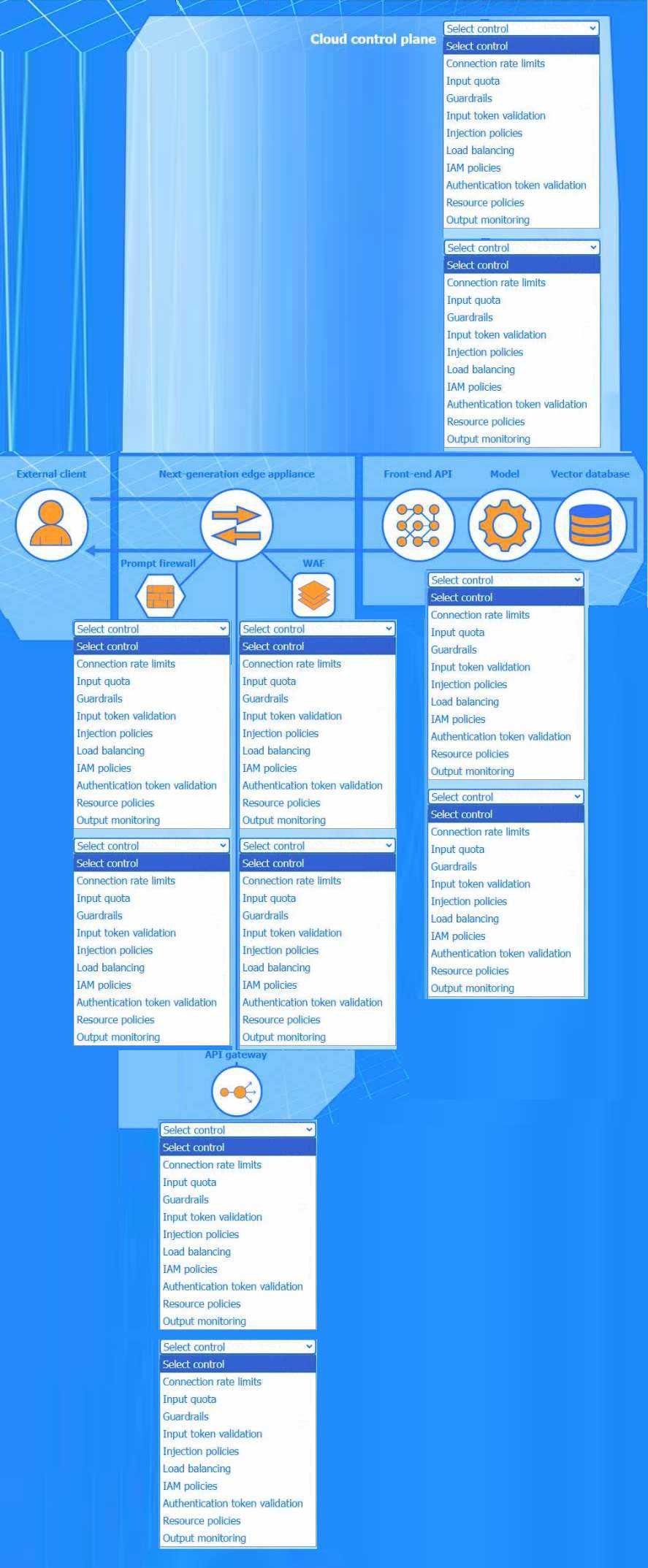
Instructions: Use the drop-down menus to define two appropriate security controls for each component of the AI system. Each control may be used only once.
An engineer is deploying a new AI system and wants to integrate it into the core system through an API.
Show answer
Correct answer

No comments yet. Start the discussion.
-
Question 4
Single answer
An organization recently created a custom model that integrates with a language model (LLM). The developer notices that the application programming interface (API) costs have increased.
Which of the following is the best control to reduce cost?
Show answer
Correct answer
-
D
Adjusting token limits
Explanation
Basic Concept: LLM API pricing is primarily based on token consumption — the number of tokens processed in both input prompts and output responses. Controlling token usage is the most direct lever for managing and reducing LLM API costs. CompTIA SecAI+ Study Guide covers AI cost management and resource controls under securing AI systems.
Why D is Correct: Adjusting token limits directly caps the maximum number of tokens used per request for both input and output. By setting appropriate token limits, the organization prevents excessively long prompts or verbose responses from consuming unnecessary tokens, directly translating to lower API costs and providing hard budget control.
Why A is Wrong: Prompt templates standardize how queries are structured, which can indirectly improve efficiency. However, they do not enforce a hard cap on token usage and cannot prevent costs from escalating with large volumes or verbose responses.
Why B is Wrong: Increasing CPU and memory addresses computational infrastructure performance on the client side. LLM API costs are billed by the API provider based on token usage, not on the client's hardware resources.
Why C is Wrong: Reducing model size means using a smaller, less powerful model version. While this may lower cost per token, it is a model selection decision, not an ongoing operational control that can be adjusted to manage cost in real time.
No comments yet. Start the discussion.
-
D
-
Question 5
Single answer
A security administrator needs to improve an AI model. During an initial investigation, the administrator notices that two successive login failures are recorded every day, and then a successful login occurs after a specific time interval. All the successful login attempts have been during office hours.
Which of the following techniques should the administrator use to improve the AI model's security?
Show answer
Correct answer
-
B
Pattern recognition
Explanation
Basic Concept: Pattern recognition is an AI technique that enables a system to identify recurring sequences or structures within data. In cybersecurity, detecting behavioral patterns such as consistent pre-login failure sequences followed by successful access is critical for threat detection. CompTIA SecAI+ Exam Objectives cover this under AI-assisted security.
Why B is Correct: The scenario describes a highly regular, repeating behavioral pattern — two failures followed by success at a specific time interval, consistently during office hours. Pattern recognition enables the AI model to learn this sequence and flag it as indicative of credential stuffing or an automated brute-force attack with timing controls. ML-driven pattern recognition is specifically designed for such behavioral anomaly detection.
Why A is Wrong: Access management controls who can log in and under what conditions. It enforces authorization policies but does not analyze or detect suspicious behavioral sequences in authentication logs.
Why C is Wrong: Signature matching compares known attack signatures against observed data. The described pattern is behavioral and time-based rather than a known malware or exploit signature, making this technique unsuitable.
Why D is Wrong: Vulnerability analysis identifies weaknesses in systems and code. It does not analyze authentication log sequences or detect behavioral patterns in user activity data.
No comments yet. Start the discussion.
-
B
- Unlock to see this question
- Unlock to see this question
154 questions locked
Unlock all 159 CY0-001 questions
You’ve had 5 for free. The other 154 work just like them: pick an answer, then check it.
- Questions
- 159, each with its answer
- Explanations
- 86% of questions explained
- Formats
- Single answer, Multiple answer, Hotspot
- Version
- 6.2
- Access
- 3 months from purchase
One-time payment
$49.00
Secure checkout